



















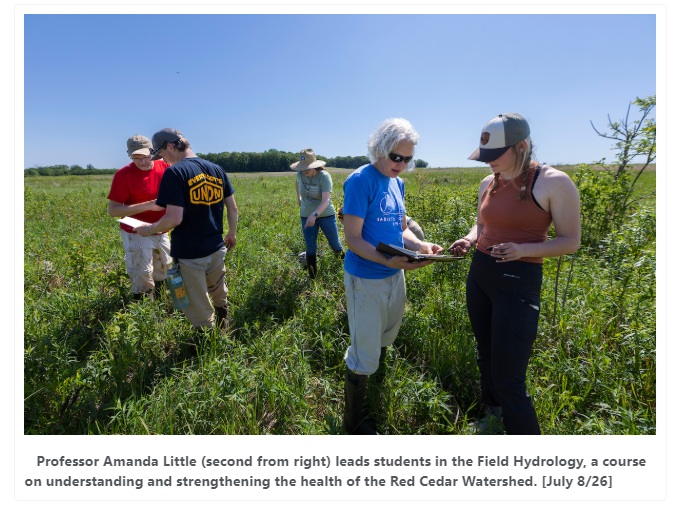
Their research is part of three of Freshwater Collaborative of Wisconsin’s longest-running programs that seek to train the next generation of water scientists: the Field Hydrology three-week advanced field course, the Red Cedar River Basin Internship Program, and the Water in Western Wisconsin: An Interdisciplinary Freshwater Field Camp for High School Students. The programs are led by UW-Stout Polytechnic’s Red Cedar Basin Monitoring Group, which works in collaboration with Universities of Wisconsin schools in its efforts. UW-Stout Polytechnic received $358,949 in grants from Freshwater Collaborative to run the three programs during the 2025-27 biennium.
Field Hydrology course
The Field Hydrology course was led by faculty from four Universities of Wisconsin, with 14 students from UW-Stout Polytechnic, UW-Eau Claire, UW-River Falls and Beloit College. Students spent a week at or near each UW campus conducting hands-on activities in water science. “By collaborating with faculty at UW-Eau Claire, UW-River Falls, and UW-Oshkosh, we created a course that lets students explore a wider diversity of water-related research and careers than is available at any one institution. Students learned from experts in the field while building on knowledge from their home institutions and emerged better prepared for careers in water resources,” said UW-Stout Polytechnic biology Assistant Professor Nicole Hayes.
Hayes and Lecturer Julia Chapman, program director of M.S. sustainable management, brought the students to Birch, Gilbert and Galloway creeks in the Red Cedar Watershed, which includes about 40,000 acres of open water and 4,900 miles of waterways in northwestern and west-central Wisconsin. Students learned to assess water quality by measuring physical and chemical variables in the stream and on land. They also collected macroinvertebrate samples and analyzed them in the lab, then calculated diversity indices and the biotic index. The students learned about soils and wetland delineation with Professor Amanda Little, program director of environmental science, and Professor Matthew Kuchta before visiting Muddy Creek wetland. They also spent time on the Kinnickinnic River at UW-River Falls.
UW-Stout Polytechnic students in the course were Cayanna Erickson, who served as a teaching assistant, and Harrison Bennett, Georgia McGrath, and Carter Tieman. The four students are also part of the Red Cedar River Basin internship program. As a teaching assistant, Erickson, who interned last summer as well, enjoyed teaching her fellow interns how to conduct stream sampling, seeing them each gain skills ranging from stream monitoring to wetland delineation and from understanding how geology impacts aquatic systems, and seeing their growth in the professional world, she said.
“I think what is most interesting to me about participating in these activities is the various skills that I have developed in these experiences, as well as assisting others in developing those skills, from stream monitoring to wetland delineation, and how geology impacts aquatic systems. Collaboration between various universities is extremely important because not all faculty members are able to teach every skill necessary for the professional world. Collaborating also allows students to learn a variety of skills from professionals that they may not have learned otherwise,” she added. “My goals for my research are to solidify a sampling protocol that future interns are able to replicate and continue for a long-term monitoring program.”