











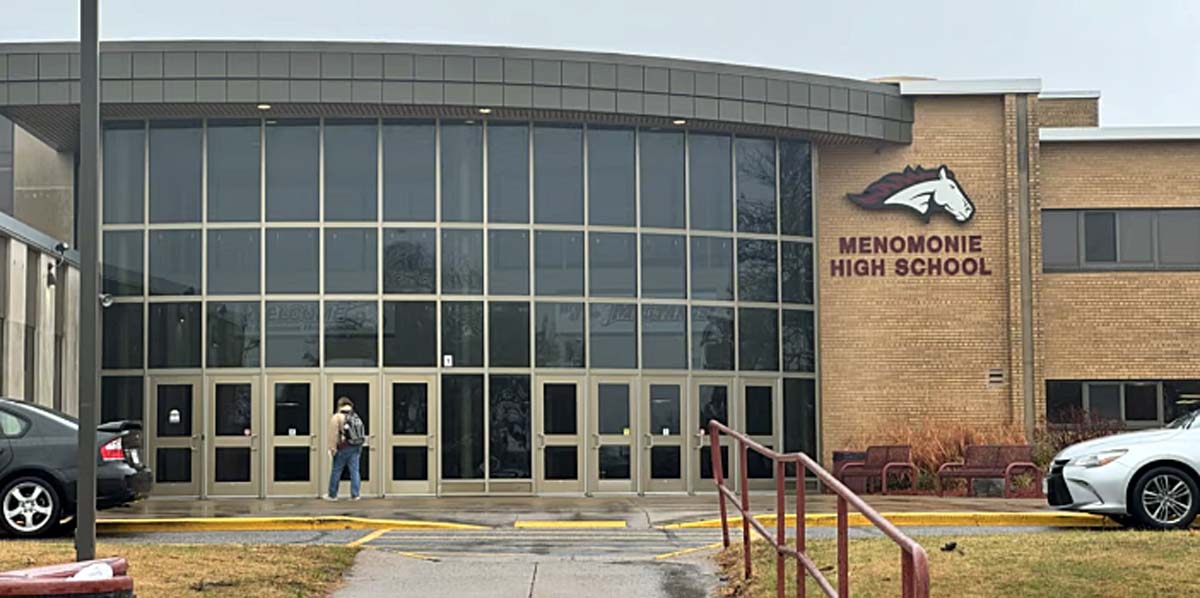





Friends, this week’s article is especially meaningful to me. Why? Because the subject—Linda Russell—is not only a (1967) classmate of mine but is also a dear friend. If you’ve been in Menomonie for a while, you may remember John and Lou Russell and their remarkable family.
Linda began telling her story, starting with her family. “My parents, John and Lou Russell, were part of the group that saved the Mabel Tainter Theater from the wrecking ball. It was destined to be destroyed to make room for an office building and parking lot! After the theater had been renovated, John and Lou were instrumental in founding the Menomonie Theater Guild. My dad was in the plays, and my mom did the makeup—so I grew up backstage helping my dad learn his lines – and waiting for my day to ‘take the stage’ myself!”
That opportunity came when Linda performed in The Crucible and in James Thurber’s The Male Animal. Her summer job after high school was giving tours of the Mabel. “So a lot of my life in Menomonie was bound up in that building!”
One of Linda’s strongest memories of her years at MHS was playing Mrs. Gibbs in Our Town directed by speech teacher David Blank. She also reminisced about an amazing high school music course taught by band director Larry Frost. As Linda said, “I learned to love opera by way of La Boheme. We’d lay our heads on our desks and listen deeply to Debussy’s Prelude to the Afternoon of a Faun. It was brilliant teaching and an unforgettable experience!”
Besides theater, Linda was involved in band, choir, and forensics as well as a member of Red Cedar 4-H Club, participating in plays and music.
Linda shared other music experiences: “I was also in both band and choir in high school. Instrumentally, I had a checkered career. I played flute in band and was last chair! I also took five years of piano with Miss Roach who would come to my house for the lessons. I was terrible! Who would ever think that I would become a musician? Well, it turns out that I wasn’t good at ‘formal’ music, but luckily it was the age of folk music.”
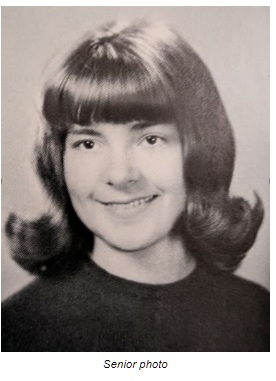
“My brother Jeff bought a guitar from the Farmers Store, and my sister Cindy and I kept sneaking into his room to try it out. Finally, we ordered our own Sears Silvertone guitar which was delivered to our rural mailbox. I began to play tunes by Peter, Paul and Mary as well as Simon and Garfunkel. After I learned that there were stories behind some of those traditional tunes, my life’s work was laid out for me! I began to learn the folk songs of the past. My dad and I traveled to local clubs and historical societies. He would show slides of the old lumbering days and I would sing old lumberjack songs.”
After high school graduation, Linda attended UW-Eau Claire where she became involved in theater and was cast as a freshman in A Man for All Seasons plus three other plays over her time there—A Streetcar Named Desire, The Heiress, and The Man of La Mancha. “Judy Berg Foust and I also had our own folk duo—Leitmotif—that performed when we were students at UW-Eau Claire.”
Upon college graduation, Linda auditioned for the American Academy of Dramatic Arts in New York. Three weeks later, she was taking her first solo cab ride from LaGuardia Airport to Manhattan!
After graduating the Academy, her improv teacher had formed a company that performed off-off Broadway shows and Linda began performing. She received positive reviews from The Village Voice and the New York Times. She thought she’d “arrived as an actress.” However, soon the company folded and Linda was on her own. She realized she was still too shy to make the rounds trying to convince agents and directors that she was the right choice for a role.
One day she stumbled into Federal Hall National Memorial on Wall Street—the site of President Washington’s inauguration —and asked about being a tour guide. They were looking for a new and unique way to interpret history and ended up creating a role for Linda as a historical balladeer for the National Park Service.
For the next 16 years Linda sang 18th century American songs for tourists, school children, and Wall Street businesspeople on their lunch hours. Linda shared she found out that years after leaving the Park Service people would still ask, “Where is the lady who sings?”
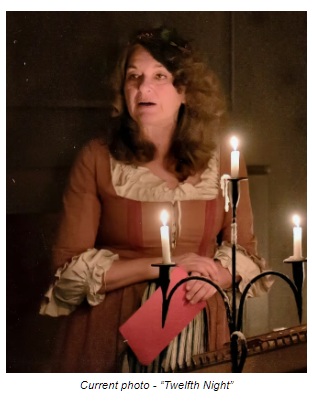
One of Linda’s most notable moments was singing at the Carnegie Hall Folk Festival while five days overdue with the birth of her daughter Hallie. She was booked to sing with Tom Paxton and Mike Seeger and she didn’t tell them about her condition, figuring it would all work itself out. “After all,” she thought, “if pioneer women could plough, plant, and give birth in the fields, I could give birth after Carnegie Hall!” Five days after her performance, daughter Hallie was born. (Note: Hallie is now 33 years old and an elementary music teacher in Brooklyn. She also plays the fiddle and guitar in her own folk band).
Linda currently lives in the apartment on New York’s Upper West Side where she’s been since 1974. After leaving Federal Hall in 1988, she’s been freelancing around the country at schools, historical sites, and community organizations. Linda has recorded eight albums of early American music.
Linda loves the variety that her job gives her. She recently sang at Grant’s Tomb to celebrate Julia Grant’s 200th birthday; she will appear at a candlelit historic tavern on Staten Island singing both traditional tunes as well as songs about her childhood in Wisconsin.
“I feel that I have the best of both worlds. I live in a city but sing in venues that have taken me from the Oregon Trail to the Adirondack Mountains. I live three blocks from the Hudson River where I frequently see red-tailed hawks and eagles on my daily walks.”
“My Wisconsin roots run very deep, and I treasure all they have given me.”
Judy Foust is a retired longtime 7th Grade Reading Specialist at Menomonie Middle School. To submit info to her or to request an interview she may be contacted at [email protected]
